
The idea of reinforcing resin-based materials with fibers is nothing new in dentistry. For decades, researchers have looked for ways to improve the mechanical properties of resin composites. These materials stand out for their esthetics and bonding ability, but they have historically had some limitations, including difficulty in stopping cracks from propagating and eventually leading to fractures. One way to address this has been to incorporate fiber structures into the resin matrix, with the aim of absorbing stress and redistributing masticatory loads.
What is Ribbond and what is it supposed to do clinically?
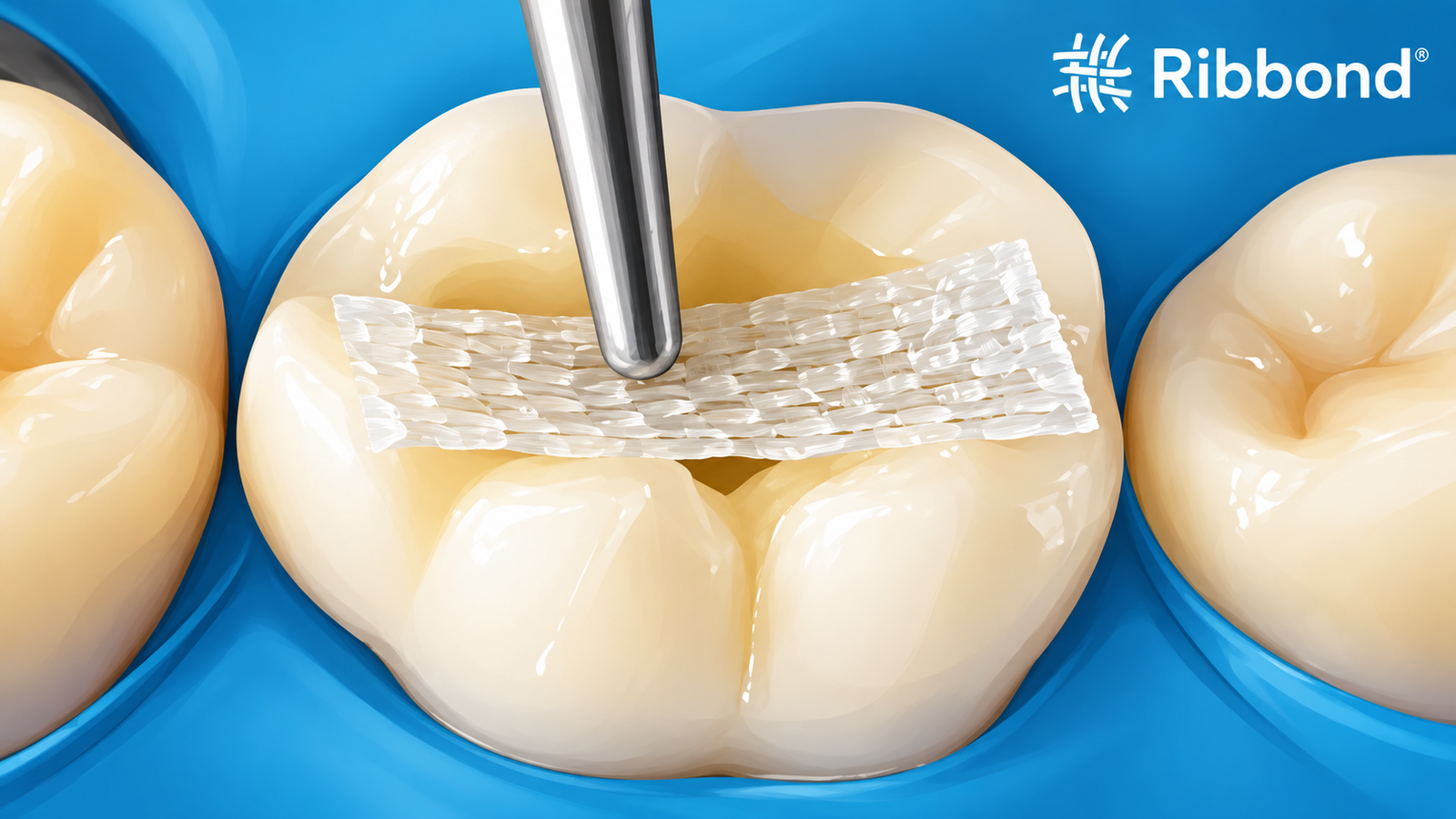
Among the different fibers available, Ribbond has been one of the most widely studied. It is a woven ribbon with a patented leno-weave design, made from ultra-high molecular weight polyethylene (UHMWPE) fibers. Its open mesh structure and plasma treatment allow flowable resin or adhesive to penetrate and wet the fiber, making it easy to adapt to the shape of the cavity.
In contemporary restorative dentistry, one of the main uses of Ribbond is not simply to reinforce the restorative material itself, but to reinforce structurally compromised or severely weakened teeth, such as endodontically treated teeth or teeth with wide MOD cavities, before restoring them.
Over the past 20 years, several studies, mostly in vitro, have looked at whether placing Ribbond beneath resin composite restorations increases fracture resistance and whether it changes the way the tooth behaves when it eventually fails.
The Bijelic-Donova et al. review on fiber reinforcement
In early 2025, a systematic review and meta-analysis was published with Dr. Jasmina Bijelic-Donova, from the University of Turku in Finland, as first author.
The study aimed to take a closer look at the real role of fiber reinforcement in structurally compromised teeth restored with resin composite, focusing on two main outcomes: fracture resistance and fracture pattern.
The review focused on two of the main commercially available fiber technologies:
- everX Posterior (GC): a resin composite reinforced with short, discontinuous glass fibers.
- Ribbond (Ribbond, Inc.): a bidirectional woven fiber made from ultra-high molecular weight polyethylene (UHMWPE).
To account for differences in anatomy and loading between different tooth types, the authors also analyzed premolars and molars separately.
Role of Ribbond in molars
Although the Bijelic-Donova et al. review contains useful information across all the subgroups they analyzed, I wanted to focus specifically on what they found for Ribbond in molars.
This is one of the most common situations in everyday practice, and molars are also the teeth exposed to the highest masticatory loads.
Overall, the meta-analysis included 7 in vitro studies evaluating Ribbond in molars with large cavities. The results showed that including Ribbond in the restorative procedure significantly increased fracture resistance compared with conventional resin composite restorations, with an average increase of approximately 250 Newtons.
Still, these numbers raise two important clinical questions for me:
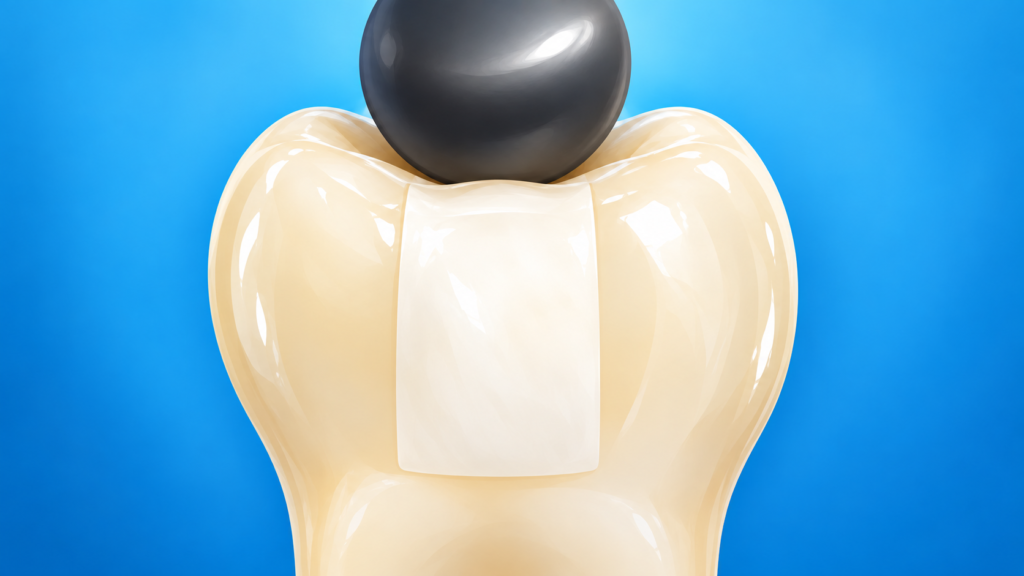
- All 7 studies used a static fracture resistance test, which does not reproduce what happens clinically: in the laboratory, a progressive and constant force is applied through a spherical metal loading tip until the tooth fractures. In the mouth, however, teeth are repeatedly exposed to much smaller loads during mastication, and fatigue accumulates over time. Although three of the seven studies performed thermocycling beforehand, none subjected the specimens to chewing simulation or cyclic mechanical fatigue before the final fracture test.
- The values are far above normal human physiology: in these 7 studies, the compromised molars restored only with resin composite (the control groups without fiber) had an approximate arithmetic mean of the reported means of 1240 Newtons (with individual studies ranging from around 700 N to more than 1700 N). This is well above the maximum bite force usually recorded in the molar region, which rarely exceeds 600–800 N.
A static load-to-fracture test is very useful for comparing materials and restorative techniques, but it only tells us part of the story. It does not fully reproduce the behavior of a tooth exposed to cyclic loading for years.
So yes, the fact that Ribbond increases the static load required to fracture a tooth shows a mechanical advantage in this experimental model. But that alone does not tell us how large the clinical benefit would actually be.
It is also worth remembering that, from a clinical point of view, fracture resistance measured in Newtons should not be interpreted on its own.
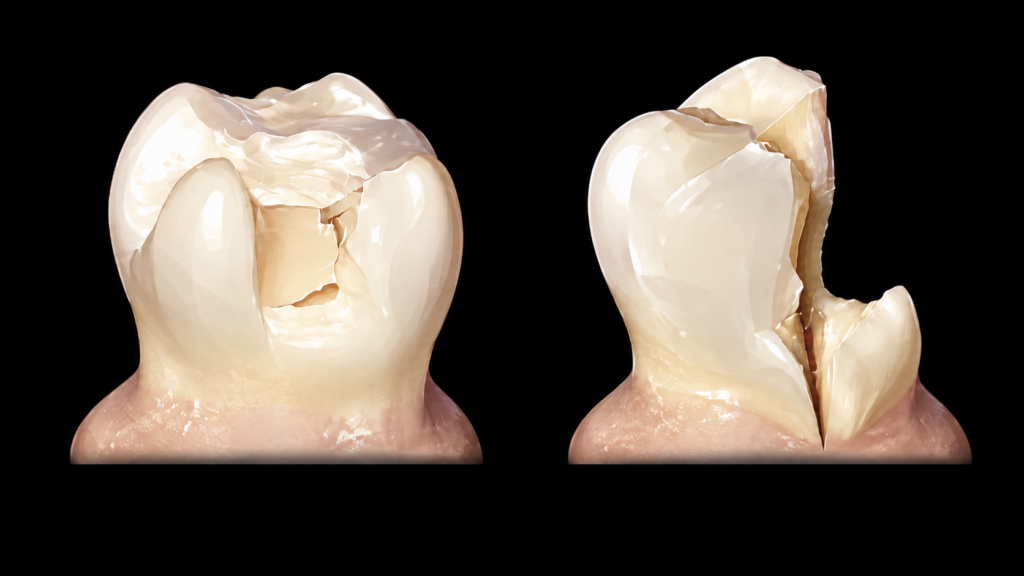
The fracture pattern matters just as much, because it often determines whether the tooth can still be repaired.
In other words, the key clinical question is not only how much force the tooth can withstand before breaking, but also where and how it breaks: above the cemento-enamel junction, where the fracture may still be repairable, or deeper toward the root, where the fracture may become catastrophic.
Ribbond in molars: does it really lead to more repairable fracture?
The authors of the Bijelic-Donova et al. review are quite positive about fiber reinforcement shifting tooth failure toward a more favorable or repairable fracture pattern.
In the abstract and conclusions, they state:
“Both fiber types (everX and Ribbond) improve fracture resistance and the fracture mode of structurally compromised teeth is equally efficient”
“To improve fracture mode, Ribbond should be placed at the cavity floor, …”
So the overall message of the review is clear: Ribbond may help produce more repairable fractures. That idea has also been widely shared in academic settings and across digital media.
But when I looked more closely at the evidence behind that statement specifically for Ribbond in molars, things became less straightforward.
Of the 7 studies evaluating Ribbond in molars, only 3 provided data that allowed favorable/repairable fractures to be compared with unfavorable/non-repairable fractures between groups with and without fiber.
In addition, none of these primary studies used inferential statistical tests, such as the chi-square test or Fisher’s exact test, to determine whether the proportion of repairable fractures was actually different between the Ribbond and non-fiber groups.
So I decided to run a post hoc statistical analysis on the data from those 3 studies.
Here is what I found:
• Akman et al. (2011): the results clearly favored Ribbond. In the control group restored with resin composite only, 10% of the fractures were repairable. In the group reinforced with Ribbond at the cavity floor, 80% were repairable. In my post hoc analysis, Fisher’s exact test showed a statistically significant association (p = 0.0055).
• Garlapati et al. (2017): 100% of the specimens in all groups, with and without fiber, showed only favorable or repairable fractures above the cemento-enamel junction. In other words, adding Ribbond did not change the failure pattern (p = 1.00).
• Sáry et al. (2019): in the resin composite-only group, 20% of the fractures were repairable, whereas placing Ribbond at the base increased that proportion to 40%. Put another way, even with Ribbond, most fractures (60%) were still catastrophic. The Fisher’s exact test I performed did not show a statistically significant association (p = 0.3008).
Clearly, these findings do not make it easy to draw a firm conclusion.
Of the 7 in vitro studies, only 3 provided data that allowed the proportion of repairable fractures to be directly compared between Ribbond and non-fiber groups. And in my exploratory post hoc analysis, only the comparison using the data from Akman et al. showed a statistically significant association between placing Ribbond at the cavity floor and a higher proportion of repairable fractures.
So, can we recommend Ribbond?
IIf you ask me, based only on the Bijelic-Donova review, we cannot say with enough scientific confidence that placing Ribbond at the cavity floor increases the likelihood of obtaining repairable fractures in structurally compromised molars.
The current evidence is limited and highly heterogeneous.
What happens to a tooth in the laboratory depends heavily on methodological factors that are not well standardized: loading speed, loading angle, cavity design, the thickness of the remaining tooth walls, periodontal ligament simulation, among others.
We also need more studies looking at biomechanical fatigue using methods that come closer to what actually happens in clinical practice.
So when it comes to advantages clearly demonstrated by scientific evidence, my recommendation regarding Ribbond would still be cautious.
That does not mean Ribbond should be dismissed as a restorative option.
Its use remains biomechanically plausible, and laboratory studies have produced promising results. What has not yet been clearly demonstrated is whether those advantages translate into a clinically meaningful and predictable benefit.
What about premolars: does Ribbond lead to more repairable fractures?
What happens in premolars?
The Bijelic-Donova et al. review identified five studies in which Ribbond groups showed more favorable fracture patterns.
However, when I looked at the original data, the picture once again became less clear than it first appeared: only one of those studies reported a statistically significant difference, while the others mainly showed descriptive differences.
In addition, four of the five studies did not simulate the periodontal ligament.
I will take a closer look at those data in a future post.
1 thought on “Ribbond in molars: does it really lead to more repairable fractures?”