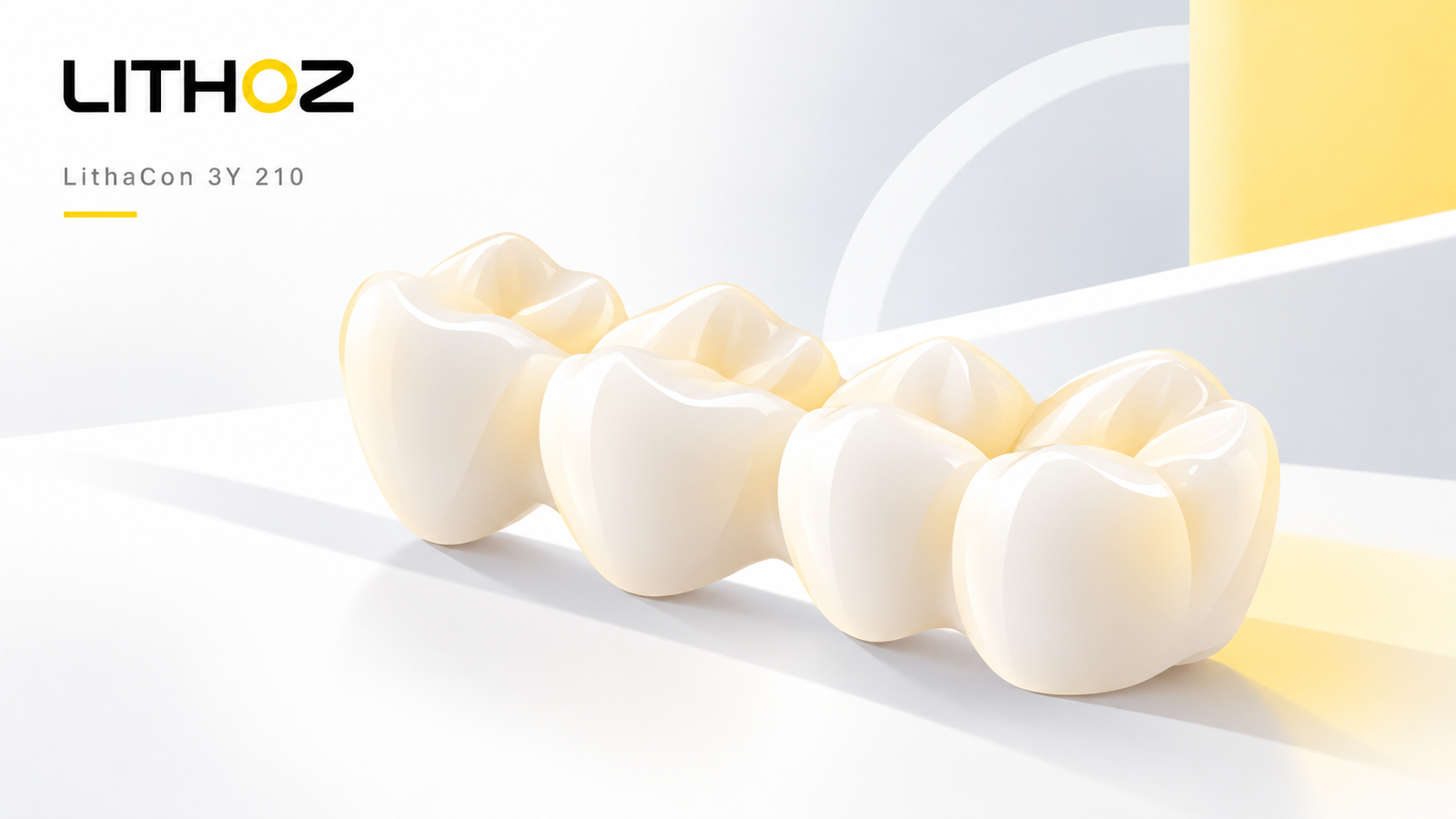
Last week, I was talking with a dentist friend about the adhesive protocol for cementing milled zirconia crowns. At one point in the conversation, I asked him: “Did you know that zirconia materials no longer have to come in discs or blocks to be milled? Zirconia can now be 3D printed.” He did not know this, so in this post I want to discuss 3D-printed zirconia, focusing specifically on one of the most extensively studied materials in dentistry: LithaCon 3Y 210.
What is LithaCon 3Y 210?
LithaCon 3Y 210 is a zirconia material for additive manufacturing developed by the Austrian company Lithoz. It is a tetragonal zirconia polycrystal stabilized with 3 mol% yttria (3Y-TZP), meaning that it belongs to the same family of high-strength zirconias commonly used in dentistry, but it is supplied and processed in a completely different way. In dental studies, it has been used to manufacture zirconia crowns, veneers, and bridges by 3D printing.
The fundamental difference is that the process does not start with a presintered disc from which material is removed by a milling machine. Instead, zirconia ceramic particles are dispersed in a photopolymerizable liquid suspension known as a slurry. This suspension makes it possible to build the restoration layer by layer. After thermal processing, the final result is no longer a “resin containing zirconia,” but a dense ceramic structure.
How is zirconia 3D printed?
LithaCon 3Y 210 is processed using Lithography-based Ceramic Manufacturing (LCM), a technology whose development began at the Vienna University of Technology (TU Wien). There, Johannes Homa and Johannes Benedikt worked as researchers in ceramic additive manufacturing and, after several years of research, founded Lithoz in 2011. LCM is based on vat photopolymerization, and its principle is somewhat similar to that of resin 3D printers commonly used in dentistry, with the important difference that the liquid material contains a high concentration of ceramic particles.
The process begins with the digital design of the restoration. The zirconia suspension is placed in the printer, and a build platform comes into contact with a thin layer of the material. From below, a blue-light source projects the image corresponding to each layer using a digital micromirror system. The light selectively polymerizes the organic component of the suspension, holding the zirconia particles in the desired position. This procedure is repeated layer by layer until the restoration is completely formed.
However, once printing is finished, we still do not have a completed zirconia crown. The initial result is what is known as a green body: zirconia particles held together by an organic matrix. The restoration must then be cleaned and undergo two essential thermal-processing steps. First comes debinding, which eliminates the organic component; this is followed by sintering, which densifies the zirconia and gives it its final mechanical properties.
Printing only generates the initial geometry; the transformation into a dense ceramic occurs during the subsequent thermal processing. In other words, rather than producing a crown by removing material from a zirconia disc, additive manufacturing builds the restoration layer by layer and subsequently transforms it through sintering into a dense ceramic structure.
What do the studies say about LithaCon 3Y 210?
One of the first studies focusing directly on restorations was published by Lerner et al. (2021). The researchers fabricated monolithic crowns using LithaCon 3Y 210 and compared them with milled zirconia crowns. The milled crowns reproduced the digital design with greater trueness, particularly at the occlusal and marginal surfaces. Nevertheless, both manufacturing methods achieved high clinical accuracy in aspects such as marginal adaptation and proximal contacts.
Along the same lines, Rues et al. (2023) compared the adaptation of anterior veneers only 0.5 mm thick manufactured with LithaCon 3Y 210 and with milled zirconia. The milled veneers showed better marginal adaptation; however, the printed restorations reproduced certain areas of complex geometry more accurately, particularly at the incisal region, where the diameter of milling burs limits what can be produced by subtractive manufacturing. This study illustrates one of the potential advantages of 3D printing: the ability to manufacture thin structures or geometries that are difficult to achieve with milling instruments.
It is important to emphasize that these studies compared restorations produced using two different manufacturing workflows: one additive and the other subtractive. Their findings should therefore not be interpreted simply as an isolated comparison between the intrinsic properties of two zirconia materials, nor should the differences be attributed exclusively to the type of machine used, since each workflow involved specific materials and processing conditions.
Regarding mechanical properties, the results are quite promising. A comparative study by Revilla-León et al. (2022)found a mean flexural strength of 1518.9 ± 253.9 MPa for LithaCon 3Y 210, significantly higher than the 980.5 ± 130.3 MPa obtained for the milled zirconia used as the control (3Y-TZP Priti multidisc ZrO2, Pritidenta). A subsequent study by Alhotan et al. (2025) found that LithaCon 3Y 210 maintained higher fracture toughness than the milled zirconia (3Y-TZP Initial Zirconia ST, GC), even after artificial aging in an autoclave. Naturally, these findings correspond to specific comparisons between materials and do not allow us to conclude that all 3D-printed zirconia is mechanically superior to all milled zirconia.
More recently, more demanding prosthetic structures have begun to be evaluated. In 2025, Dagistan et al. fabricated three-unit monolithic fixed dental prostheses. LithaCon 3Y 210 reached a fracture load of 1132 ± 209 N, exceeding the 790 N threshold considered clinically relevant in the study, although the milled zirconia (GC Initial Zirconia HT, GC) showed the highest values (1670 ± 250 N).
Taken together, the laboratory findings are promising and show that LithaCon 3Y 210 can be used experimentally to fabricate structures ranging from crowns and veneers to multi-unit fixed dental prostheses. However, most of the available evidence on this material remains in vitro, and clinical studies are still needed to confirm its long-term behavior.
Can we already use 3D-printed zirconia in our patients?
From a scientific perspective, the answer requires caution. 3D-printed zirconia has already been used clinically, and the initial results are promising. In the specific case of LithaCon 3Y 210, however, the available evidence remains predominantly in vitro. Studies have shown good results in terms of adaptation and mechanical properties, but clinical studies and long-term follow-up are still lacking. Therefore, rather than considering it a routine replacement for milled zirconia at this stage, it seems more reasonable to view it as a highly promising technology for which clinical evidence is still accumulating.