
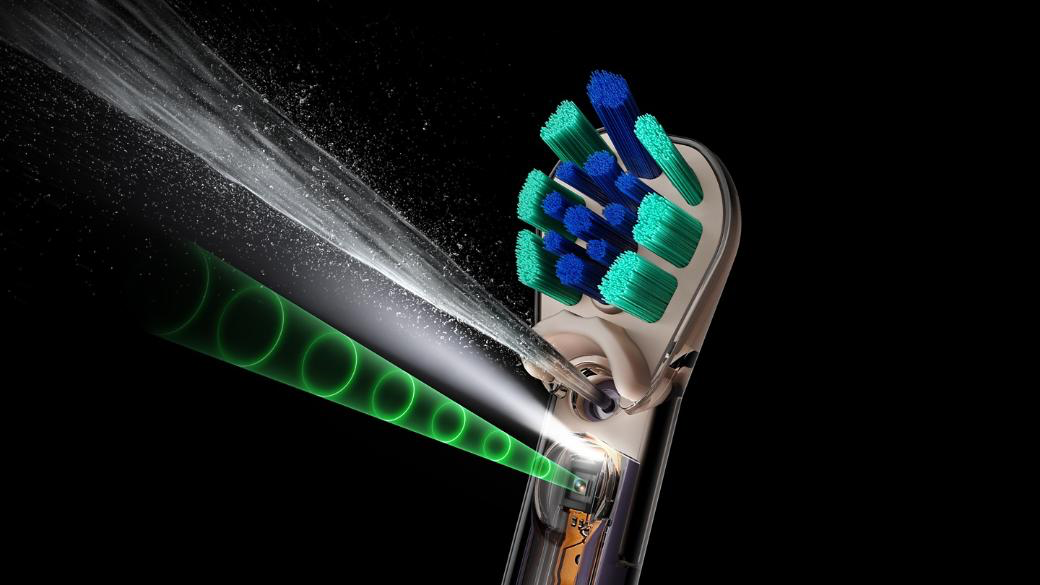
September 2026 has begun with a launch that has generated enormous media attention in the dental field. I am referring to Dyson CameraJet, the new electric toothbrush from British company Dyson, which incorporates innovative technologies and enters the market with a launch price of US$499.99.
Is Dyson CameraJet really innovative?
Electric toothbrushes have been around for a long time, but CameraJet brings together several features that are unusual in this type of device. It incorporates a camera that operates inside the mouth and is linked to an artificial intelligence (AI) system capable of recognizing interdental spaces and, based on that information, activating an irrigating jet specifically directed toward these areas to facilitate cleaning. If that sounds a little confusing, don’t worry—I’ll explain it step by step.
Intraoral cameras in toothbrushes
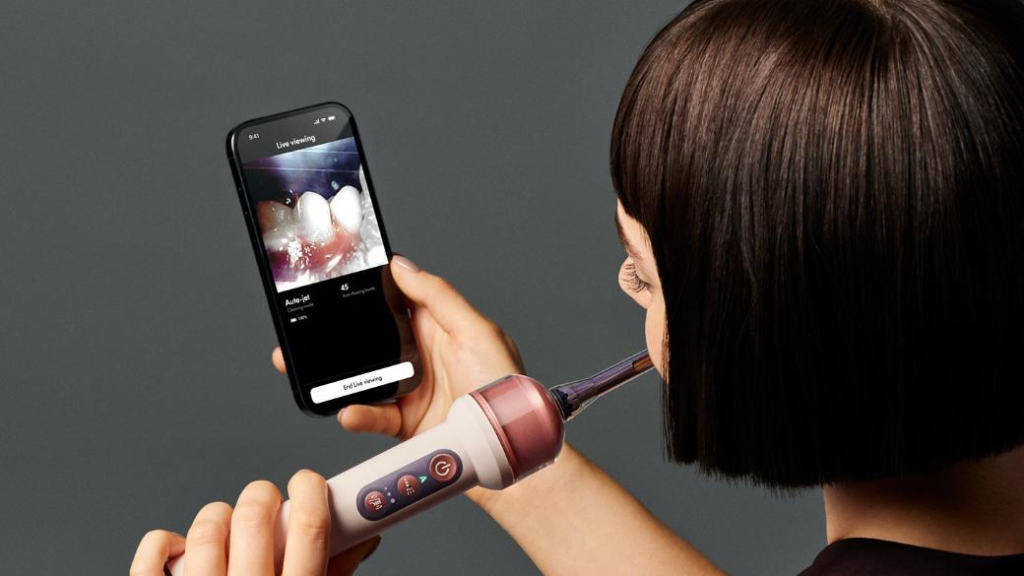
To be fair, CameraJet is not the first toothbrush to incorporate an intraoral camera. In 2016, ONVI introduced Prophix, an electric toothbrush equipped with a high-resolution camera capable of streaming video from inside the mouth to a smartphone while the user brushed. It also allowed users to take photographs and compare them over time. Other patents describing similar concepts also exist, although, of course, having a patent does not necessarily mean that a product has ever reached the market.
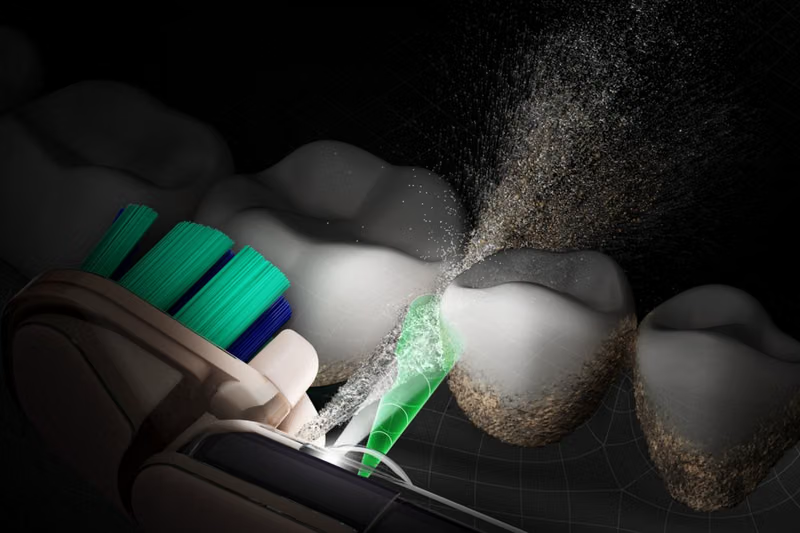
Dyson’s real innovation lies in turning the camera into an active part of the oral hygiene process: its images are analyzed using AI to recognize interdental spaces and automatically activate a jet directed toward them. In other words, Prophix used the camera so that the user could see; CameraJet uses the camera so that the toothbrush itself can see.
Artificial Intelligence in toothbrushes
I hope I’m not disappointing you, but CameraJet is not the first toothbrush to incorporate AI either. Several have already done so, starting with the pioneering Kolibree Ara, introduced in 2017, followed by better-known products such as the Colgate E1, Oral-B Genius X, Oral-B iO, and the recently launched Philips DiamondClean 9900 Prestige.
Kolibree Ara, for example, used accelerometers, gyroscopes, and a magnetometer to recognize which areas of the mouth were being brushed and then transmit that information to a smartphone app. The Colgate E1 followed a similar approach and was introduced in 2018 as an AI-powered connected toothbrush capable of providing real-time feedback on brushing.
This concept was later developed further by other manufacturers. In general terms, these systems use information from motion, position, or pressure sensors to estimate which areas have been brushed and which have been missed. Users can then view this information through graphical representations of the mouth and review parameters such as brushing coverage, brushing time, and, depending on the model, the amount of pressure applied.
In fact, in July 2026 Philips introduced a new generation of the DiamondClean 9900 Prestige featuring AI processing directly on the device and a mouth map that provides real-time information about brushing coverage.
Dyson’s approach with CameraJet is different. Rather than using AI primarily to interpret the movements made by the user while brushing, CameraJet directly analyzes the images captured by its camera. Its Gap Optical Targeting system identifies, tracks, and predicts the position of interdental spaces so that the irrigating jet can be activated precisely when needed. The camera analyzes 28 images per second, with processing taking place in real time.
Irrigation systems integrated into toothbrushes
Once again, CameraJet is not the first toothbrush to incorporate an irrigation system. In 2018, Waterpik launched Sonic-Fusion, a device that combines a sonic toothbrush with an oral irrigator. The water jet emerges from the center of the brush head, and users can choose between brushing, irrigating, or performing both functions simultaneously using buttons on the handle.
More recently, in 2023, Soocas introduced NEOS, a portable device that integrates an electric toothbrush and an oral irrigator into the same unit. Unlike Sonic-Fusion, which uses an external reservoir connected to the handle, NEOS incorporates both the reservoir and the pumping system within the device itself. Its successor, NEOS II, retains this concept and features an internal 50 mL reservoir.
Therefore, combining brushing and irrigation in a single device is not a new idea either. Once again, what makes CameraJet different is how it uses this technology: in automatic mode, the user does not need to decide exactly when to activate the jet. The camera locates the interdental space, the algorithm interprets the image, and the device automatically releases a small amount of liquid toward that area. Dyson uses a cone-shaped jet for this purpose, capable of dispensing up to 0.15 mL per activation.
Seen from this perspective, Dyson CameraJet did not invent the camera in a toothbrush, artificial intelligence, or integrated irrigation. Its real innovation lies in connecting all three technologies: the toothbrush sees, interprets what it sees, and acts accordingly.
Is Dyson CameraJet effective?
Now that you understand why CameraJet has attracted so much attention, you are probably asking yourself a much more important question: does it really clean between the teeth well enough to eliminate the need for dental floss?
I think it is still too early to answer that question.
Dyson presents results from laboratory testing and also reports a clinical study involving 204 participants over six weeks, in which CameraJet was used twice daily in Brush + Auto-jet mode and compared with a manual toothbrush. According to the company, the device achieved better outcomes related to plaque control and gingival health.
However, these data should be interpreted with caution. So far, I have not found independent, peer-reviewed scientific studies specifically evaluating the clinical effectiveness of CameraJet. Moreover, comparing it with a manual toothbrush does not necessarily answer what is probably the most relevant question from a dental perspective: can its interdental cleaning system provide results comparable to those achieved with dental floss, interdental brushes, or conventional oral irrigators?
To answer this question, we will need studies evaluating, among other aspects, how accurately the system recognizes different interdental anatomies, whether the characteristics and pressure of the jet are sufficient to effectively remove biofilm, how well it cleans at the subgingival level, and how it performs compared with other interdental hygiene methods.
What we do know is that conventional oral irrigators are not a new technology, and scientific literature has already evaluated their effectiveness compared with other interdental hygiene methods. CameraJet, however, presents a different scenario because it uses computer vision to automatically determine where the jet should be directed.
For now, I think the most prudent approach is to wait for independent studies that will allow us to distinguish between two things that are not necessarily the same: a truly innovative technology and a clinically superior technology.