I recently read a scientific article by Maucoski et al. (2026) comparing the characteristics of eight contemporary multi-peak LED light-curing units (LCUs). What I found particularly interesting about this study, co-authored by Prof. Richard B. Price, was that, rather than simply comparing the total radiant power of each unit, the authors also analyzed how that power was distributed across the emission spectrum. Since these units are designed to emit light over different spectral ranges, the researchers determined how much radiant power was emitted in the blue region and how much in the violet region.
Why does blue versus violet light matter?
This comparison caught my attention because total radiant power is frequently discussed, and we know how important it is when evaluating a light-curing unit. Based on the radiant power and the emitting area of the light tip, the irradiance reported for the unit can be calculated and expressed in mW/cm². (Technically, what is commonly referred to as irradiance when describing the light emitted from the tip is more accurately termed radiant exitance or radiant emittance).
We also know that there is a sound theoretical reason for LED curing units to emit not only blue light but also some violet light: the latter can activate specific alternative photoinitiators. While camphorquinone responds primarily to blue light, alternative photoinitiators such as TPO and Ivocerin show greater absorption at wavelengths within the violet region.
However, considerably less attention is paid to how much of the output from a multi-peak LED actually corresponds to blue light and how much corresponds to violet light. If we consider the total radiant power emitted within the evaluated wavelength range as 100%, the proportion assigned to each spectral region will depend on the type, number, and arrangement of the light-emitting diodes. Part of the total output will correspond to blue emission and another part to violet emission. Moreover, manufacturers do not usually provide this information in detail.
Woodpecker X-Star versus VALO X
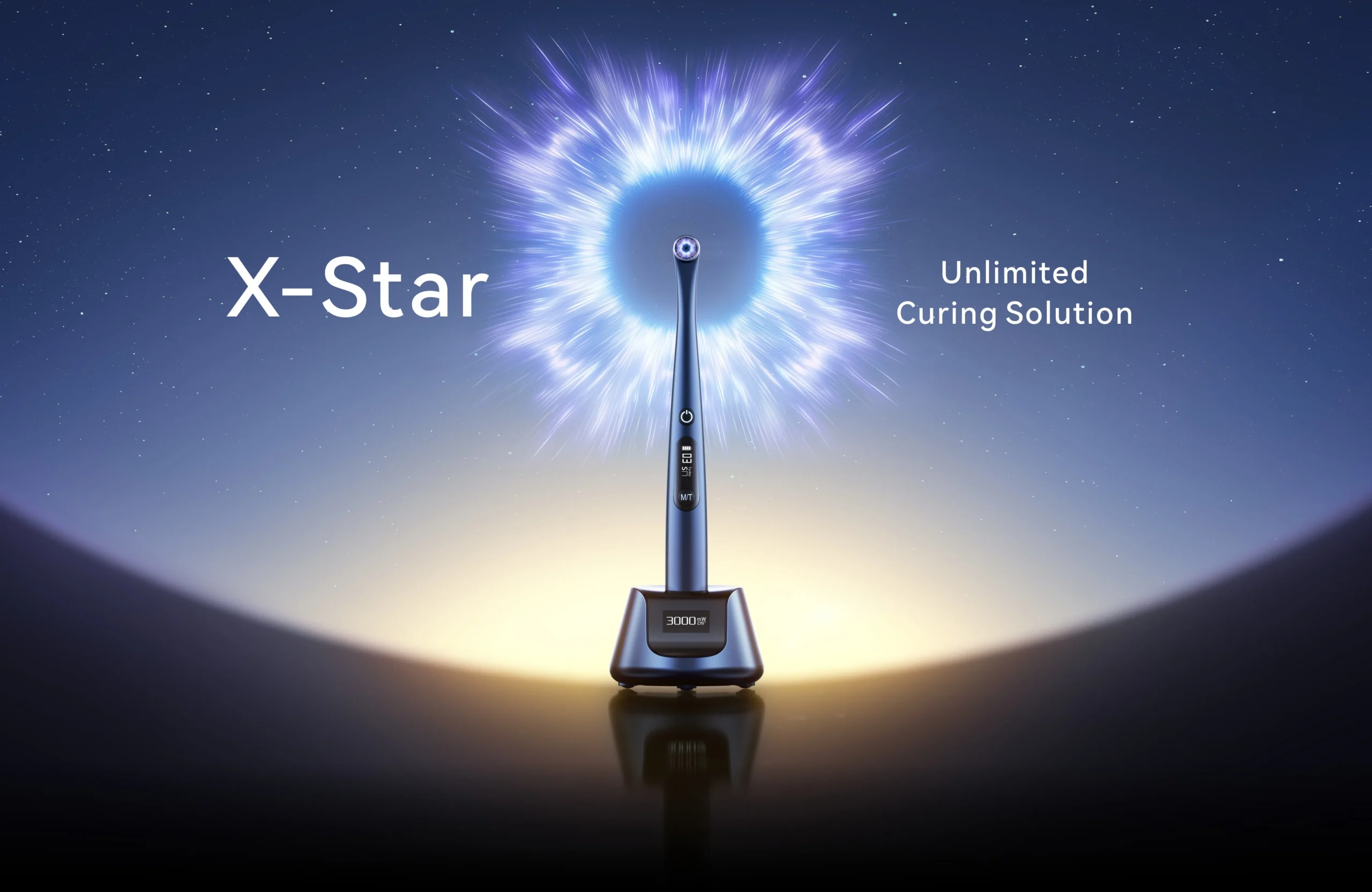
One of the findings that caught my attention in the study by Maucoski et al. involved the Woodpecker X-Star curing light. The X-Star produced remarkably high radiant power in the blue spectral region, even exceeding the VALO X from Ultradent in the highest-power mode tested—a curing light from a product family that has long been regarded as a benchmark in this category.
| Unit (Mode) | Total Power | Blue-Light Power | Violet-Light Power |
|---|---|---|---|
| X-Star (Normal – 10 s) | 1180 ± 4 mW | 992 ± 5 mW | 187 ± 1 mW |
| VALO X (Standard – 10 s) | 1535 ± 2 mW | 1126 ± 1 mW | 408 ± 1 mW |
| X-Star (Turbo – 3 s) | 2963 ± 4 mW | 2419 ± 4 mW | 540 ± 0.4 mW |
| VALO X (Xtra Power – 5 s) | 3114 ± 14 mW | 2236 ± 11 mW | 875 ± 3 mW |
Source: Maucoski et al. (2026). Values are expressed as mean ± standard deviation.
When we compare only the two LCUs with the highest outputs in the study, VALO X produced greater total, blue, and violet radiant power in Standard/Normal mode. However, when the highest-power mode of each unit was compared—Turbo for the X-Star and Xtra Power for the VALO X—the X-Star delivered greater blue-light radiant power.

This is not a trivial detail. For many years, Ultradent’s VALO curing lights stood out among commercially available light-curing units because of their high power and irradiance, particularly in their high-power modes. This characteristic helped establish the VALO family as a benchmark within this category.
The findings reported by Maucoski et al., however, illustrate how technological development has considerably narrowed that gap. In their respective maximum-power modes, the X-Star not only approaches the VALO X in total radiant power—with both producing approximately 3000 mW—but actually exceeds it in blue-light radiant power.
The era of dominance in high-power output appears to be coming to an end.
But how much violet light do we actually need?
There is still another question that I find even more interesting. Considering that the role of blue light in achieving optimal polymerization of resin-based dental materials is quite clear: how important—and how necessary—is a high violet-light output, given that, due to physical phenomena, violet wavelengths have a much more limited ability to penetrate restorative materials?
In other words, what is the benefit of having a curing light with substantial violet emission if that light cannot effectively reach deeper regions of the material?
And what does the scientific evidence tell us about the actual effect of violet light on the properties of restorative materials containing alternative photoinitiators?
That will be the subject of upcoming posts.