

Imagine reading a scientific paper comparing two restorative materials. In the conclusions, the authors claim that one performs better than the other. However, when you examine the results, you discover that although one material yielded higher numerical values, the difference between the two was not statistically significant. Sound familiar?
This is one example of what researchers call spin, a phenomenon that has attracted growing attention in the dental literature.
In fact, a few weeks ago, I published an analysis of a systematic review on the use of Ribbond and its influence on fracture patterns in restored molars. In that analysis, I identified a possible overinterpretation of the findings that could be considered an example of spin.
What is spin?
In scientific research, spin refers to the way findings are presented or interpreted to make them appear more favourable, important, or promising than the evidence actually supports.
This does not necessarily mean that researchers have falsified data or engaged in scientific misconduct. Spin can occur intentionally or unintentionally, even in studies that have otherwise been conducted appropriately.
For example, spin may occur when:
- A study finds no statistically significant difference between two treatments, yet the authors conclude that one is superior to the other.
- The primary findings are unfavourable, but the conclusions emphasise positive secondary outcomes to create an impression of success.
- The authors recommend a material or clinical technique even though the findings do not support such a recommendation.
- The benefits of an intervention are highlighted, while its potential adverse effects receive little attention.
In all these situations, the problem does not necessarily lie in the data themselves, but rather in how they are communicated and interpreted.
What do we know about spin in dentistry?
Although spin has been studied in medicine for some time, several investigations published in recent years have helped us better understand its presence in the dental literature.
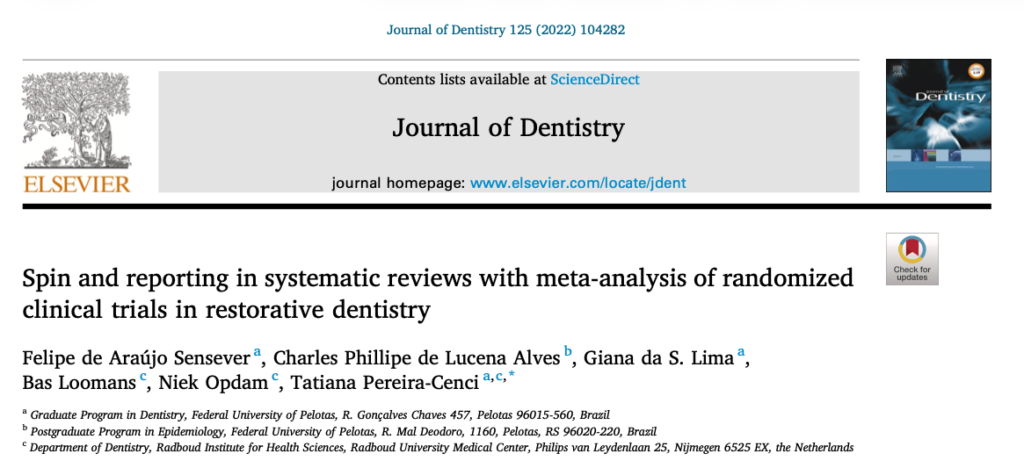
In 2022, Sensever et al. examined 49 systematic reviews with meta-analyses of restorative treatments in a study published in the Journal of Dentistry. They found a moderate prevalence of spin in abstracts and a low prevalence in full texts. One particularly striking finding was that approximately 65% of the abstracts failed to mention potential adverse effects of the interventions. Furthermore, 22.4% of the reviews included clinical recommendations in their full texts that were not supported by the findings. This study highlighted that even systematic reviews, which are frequently used to guide clinical decisions, may contain problematic interpretations.
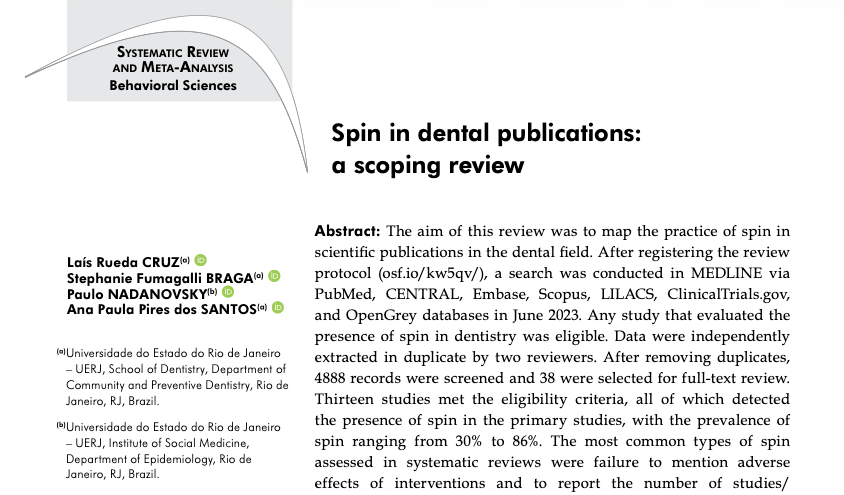
In 2024, Cruz et al. published a scoping review in Brazilian Oral Research, bringing together 13 studies investigating spin across different dental specialties, including endodontics, orthodontics, periodontology, and restorative dentistry. All 13 studies identified spin in the publications they assessed, with reported prevalence ranging from 30% to 86%. These figures should not be interpreted as the overall prevalence of spin in dentistry, as the studies used different samples and assessment criteria. Nevertheless, they show that the problem is not confined to a particular specialty or type of publication.
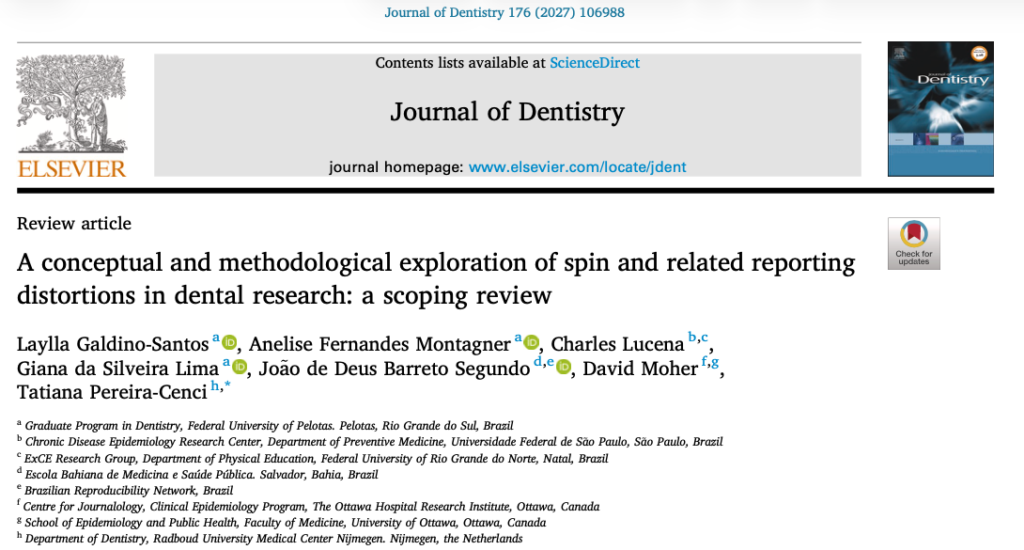
More recently, Galdino-Santos et al. expanded on these findings in a study published online ahead of print in the Journal of Dentistry, which has been assigned to the journal’s 2027 volume. Their scoping review included 30 investigations addressing spin and other distortions in the reporting and interpretation of dental research findings. One of their main observations was the considerable variation in the definitions and methods used to identify spin. In other words, although our understanding of this phenomenon continues to grow, more consistent criteria are still needed to investigate it and compare findings across studies.
Why should practising dentists care?
Because much of our clinical decision-making relies on scientific evidence.
When choosing an adhesive system, a resin composite, a restorative technique, or any other treatment, we expect the conclusions of scientific papers to accurately reflect their findings. The problem is that, often due to time constraints, we read only the abstract of a publication. And this is precisely where spin may appear, particularly in the conclusions.
This does not mean that we should distrust all research, but rather that we need to develop a more critical approach to reading scientific literature. An enthusiastically presented clinical recommendation is not necessarily supported by sufficient evidence.
Before accepting the conclusions of a paper, it is worth asking one simple question: Do the study’s findings actually support what the authors are claiming?
Recognising spin is not about questioning the credibility of every scientific publication. It is about learning to distinguish between what a study actually demonstrates and how its authors interpret the findings. Ultimately, the ability to critically appraise scientific literature is an essential part of making better clinical decisions.